
Radar – by nexxworks: Never Normal Heroes – 🏗️ Peter Hinssen and Clay Parker Jones on Org Design, Industrial Logic, and the 150-Year blueprint we inherited
Explore insights from Clay Parker Jones — Airbnb's head of organisational design and author of Hidden Patterns — on why your strategy and your structure are probably strangers to each other.

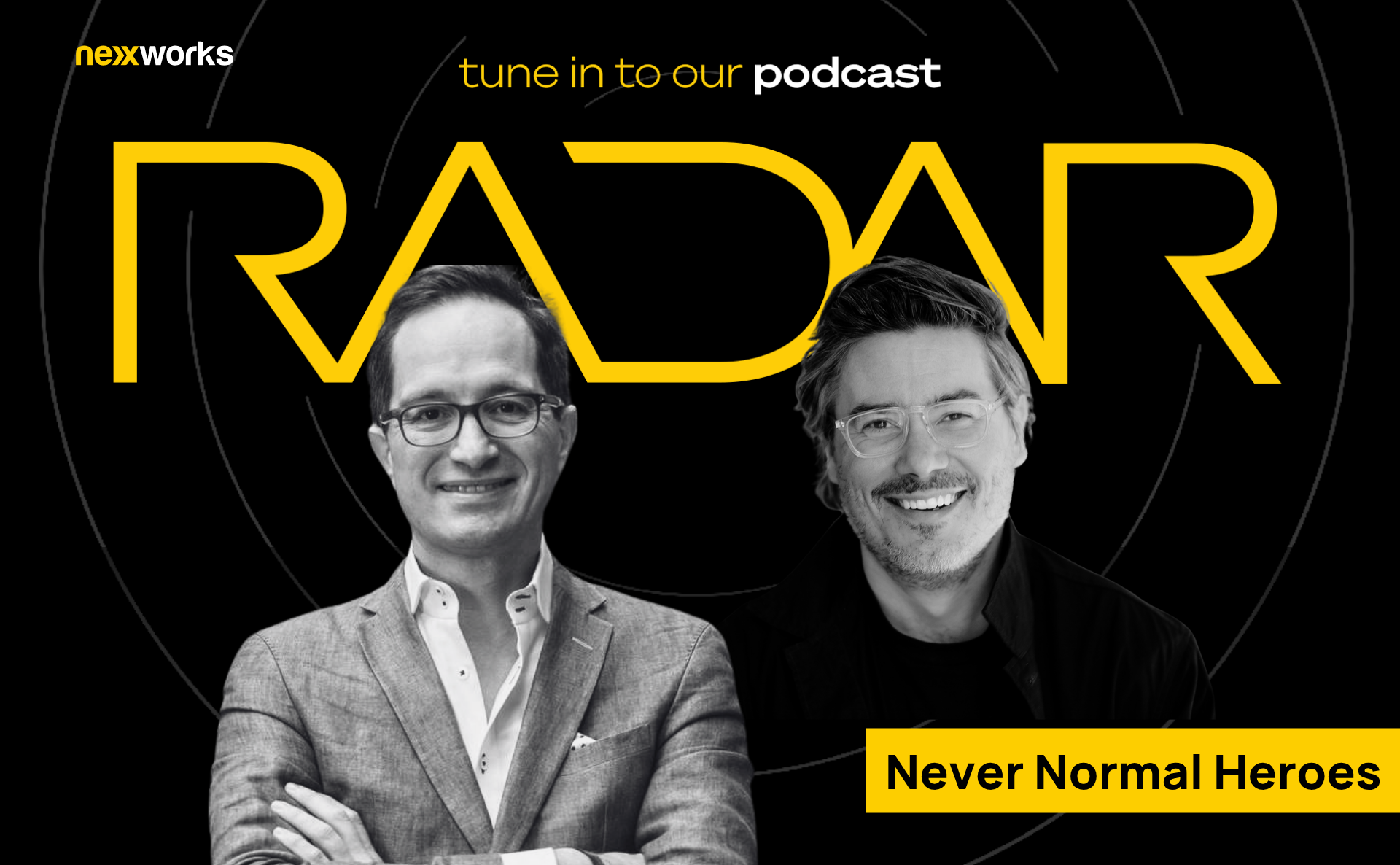
BONUS EPISODE
In this episode of Never Normal Heroes, Peter Hinssen sits down with Clay Parker Jones: Head of Organisational Design & Development at Airbnb and author of HiddenPatterns: A Playbook for More Human Workplaces, to dig into why most companies are still running on organisational blueprints drawn up 150 years ago, what it actually takes to connect strategy to structure, and why the most dangerous phrase in corporate life might be role clarity.
Our guest came to organisational design through practice more than theory. From Undercurrent to August (which he founded together with colleagues in 2015; employee owned and run without a traditional management layer) to Black Glass, and now Airbnb. Clay has spent fifteen years inside organisations running experiments on how work actually gets done, how decisions really get made, and how to close the gap between the org chart on the wall and the organisation that shows up every day. Hidden Patterns is the distillation of all of it: 75 design patterns tested in the field, a shared vocabulary for the people who want to make work less broken and a lot more human.
Peter and Clay cover the gap between strategy and structure, the ghost of the Industrial Revolution that haunts every corporate hierarchy, what holacracy actually felt like from the inside, and the essay that struck a nerve with more people than almost anything Clay has written: The End of Role Clarity.
🎧 Listen to Radar by nexxworks here:
Or listen on Apple Podcasts or Spotify
Key Takeaways
Organisational design is a strategic instrument, not an HR project. Clay's opening provocation sets the tone for the whole conversation. Borrowing from Roger Martin's "where to play, how to win" framing, he argues that if you cannot draw a clear line from your business choices to your structure, your design is decorative. The fix is not a new framework. It is making the connection explicit, legible and editable, so that when conditions change, you have something with your fingerprints on it that you can actually adjust.
Most companies are still running on design principles that are 150 years old. Peter points out that when you look at how 99% of organisations are run, you are essentially looking at a management model built to coordinate large groups of unskilled factory workers during the Industrial Revolution. It is a genuinely strange fact that organisations built around knowledge, say insurance companies, banks, technology firms, have inherited that model almost unchanged. The complexity of hierarchies that no longer work is showing up everywhere: in burnout rates, in untapped potential, in the frustration that has become background noise in most large organisations.
Role clarity is a symptom of relational poverty. Clay's essay from February 2026 became one of the most widely read things he has written in years, and the conversation explains why. The idea: when you are in a large team where 20 people are quietly competing for the next slot up and nobody really trusts each other, all you can do is negotiate your sliver of the pie. Role clarity becomes the only tool available because real relationship is absent. In a small team built on genuine trust and a shared goal, the question of where one person's role ends and another's begins is the wrong question entirely. It freezes what is possible.
Holacracy works, for a while, at a limited number of companies. Clay was inside an organisation that applied holacracy to itself from around 2012, and he is unusually candid about it: it worked. It made them more money, improved client relationships, developed more people. The proof, he argues, is in the diaspora of Undercurrent alumni who went on to start their own businesses, because everyone who worked there got genuinely good at running a business, not just executing inside one.That said, Clay is careful not to sell democracy as a model. It usually does not work. What works is intentional structure: teams that exist inside a network of other teams, with rethought definitions of management, where more people get to manage, not just the ones who happened to end up in management roles.
Haier and Gojo are the case studies worth knowing. Clay points to Haier, the Chinese(!) appliance giant that dismantled its traditional hierarchy and reorganised into thousands of micro-enterprises each operating like a startup with its own P&L, as the benchmark for what a network of teams looks like at genuine scale. Peter brings in Gojo, his favourite example of holacracy working in practice: a company that has used self-organisation not as an ideological statement but as the operational model best suited to what it is actually trying to do. Both cases make the same point: the goal is never to organise differently for its own sake. The goal is to organise in a way that builds adaptivity and the capacity to deliver. The design follows the business logic, not the other way around.
The future organisation feels smaller, even when it is not. Clay's expectation, which has started to look like a prediction, is that organisations will both be smaller and feel smaller: more local, more immediate, more like the handful of people working together toward a common cause that predates the Industrial Revolution entirely. Not a managed hierarchy. A team, with one goal or a handful, where people are there for each other and for the work. If more people end up inside more teams like that, Clay thinks we start to win.
HiddenPatterns: A Playbook for More Human Workplaces by Clay Parker Jones is available now.
This conversation is one we keep having on the road
The question Clay and Peter keep circling, whether your organisation is actually built to execute your strategy or just inherited from whoever came before, is not one you can answer from a boardroom in your own building. It takes distance, different examples, and the right people in the room together.
That is exactly the kind of conversation nexxworks designs its leadership programs around. We take executive teams out of their daily environment and into focused, immersive sessions built around one central question: is the way you are organised actually helping you win? We bring in the thinkers, the casestudies and the provocations, and we create the space for leadership teams to look at their own design honestly, together, away from the noise.
If the ideas in this episode landed and you want to take your leadership team through that conversation properly, talk to us about what that could look like for your organisation.


This might also interest you
.png)
